
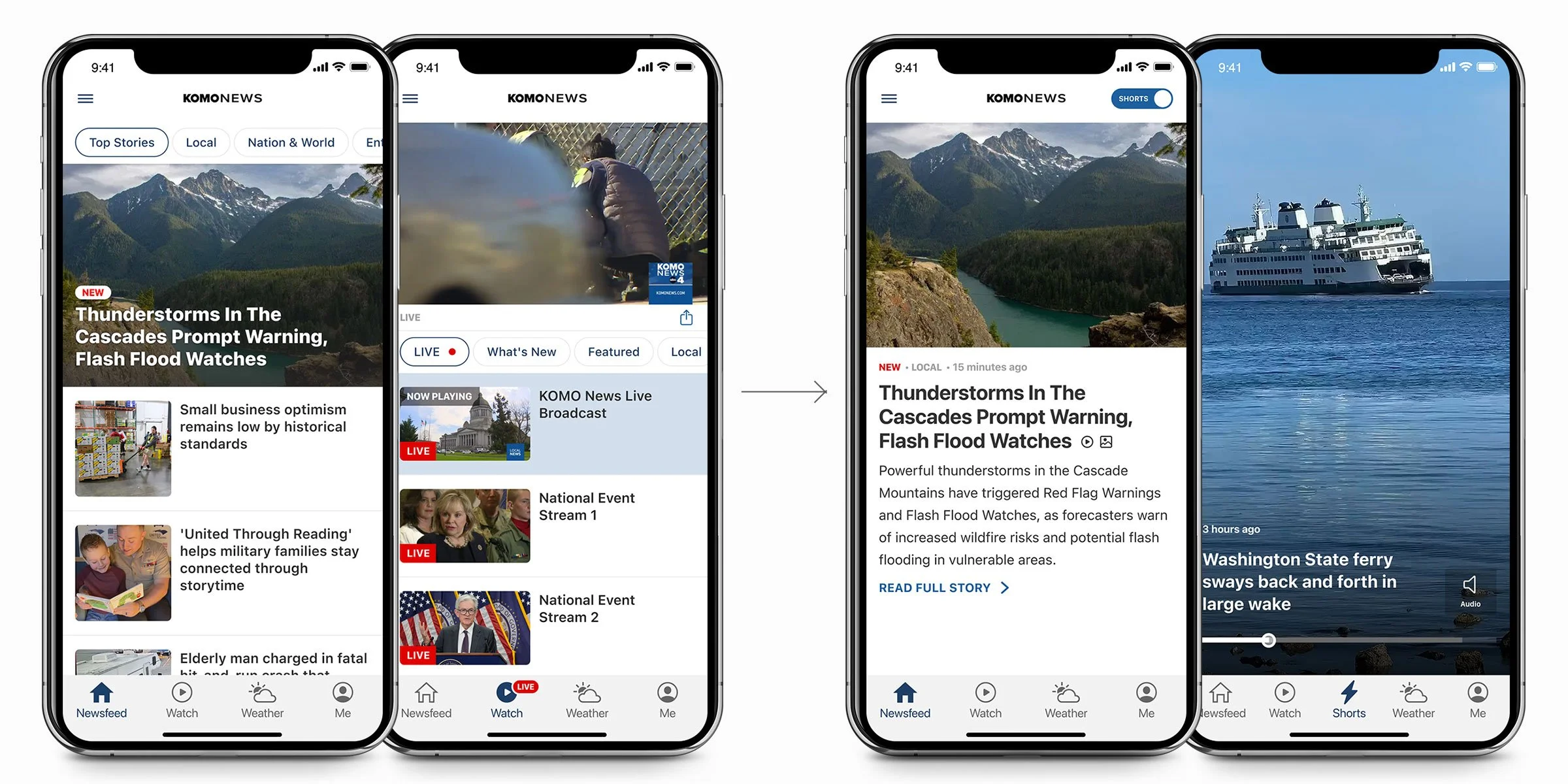
KOMO News App
Background
Sinclair Digital powers the digital mobile news experience for approximately 80 local broadcast stations across the United States, including flagship properties like KOMO News (Seattle). As the Lead Product Designer on the mobile team, I oversee the native iOS and Android apps, ensuring design consistency, scalable component architecture, and high feature engagement across diverse regional markets.
Role
I worked as part of a cross-functional team to design the end-to-end short-form experience for both iOS and Android. Based on the rollout strategy established by product leadership and stakeholders, I designed the user flows, wireframes, high-fidelity UI, and interactive prototypes for both the Video Shorts and Story Shorts features. I focused on making sure these new interactions fit smoothly into our existing white-label system across approximately 80 station brands, collaborating closely with design peers for reviews and partnering with engineers during implementation to support the phased beta releases.
Scope
The scope focused on expanding the app's core feed by designing a dedicated short-form content experience alongside the existing list view. Key design deliverables included the vertical video feed interface, AI summary card layouts, navigation controls between views, and first-time user onboarding screens. To support product strategy and technical constraints, the design system was structured to support stakeholder A/B testing and a phased rollout—prioritizing the initial video release while preparing UI components for future feature updates.
Tools Used
Figma, Adobe Illustrator
Context
The existing KOMO News app was designed around a traditional, editor-curated list of articles where users actively browsed structured headlines to discover content. While this model remained effective for long-time readers, internal data showed a strong demographic skew toward an older demographic—highlighting a growing gap between the app experience and modern content consumption behaviors.
As news consumption across digital platforms shifted toward faster, short-form, feed-based interactions, we needed to modernize the experience to attract younger audiences. The primary design challenge was integrating a dedicated short-form view alongside the traditional list view without alienating existing users or creating technical debt across our ~80-station white-label system.
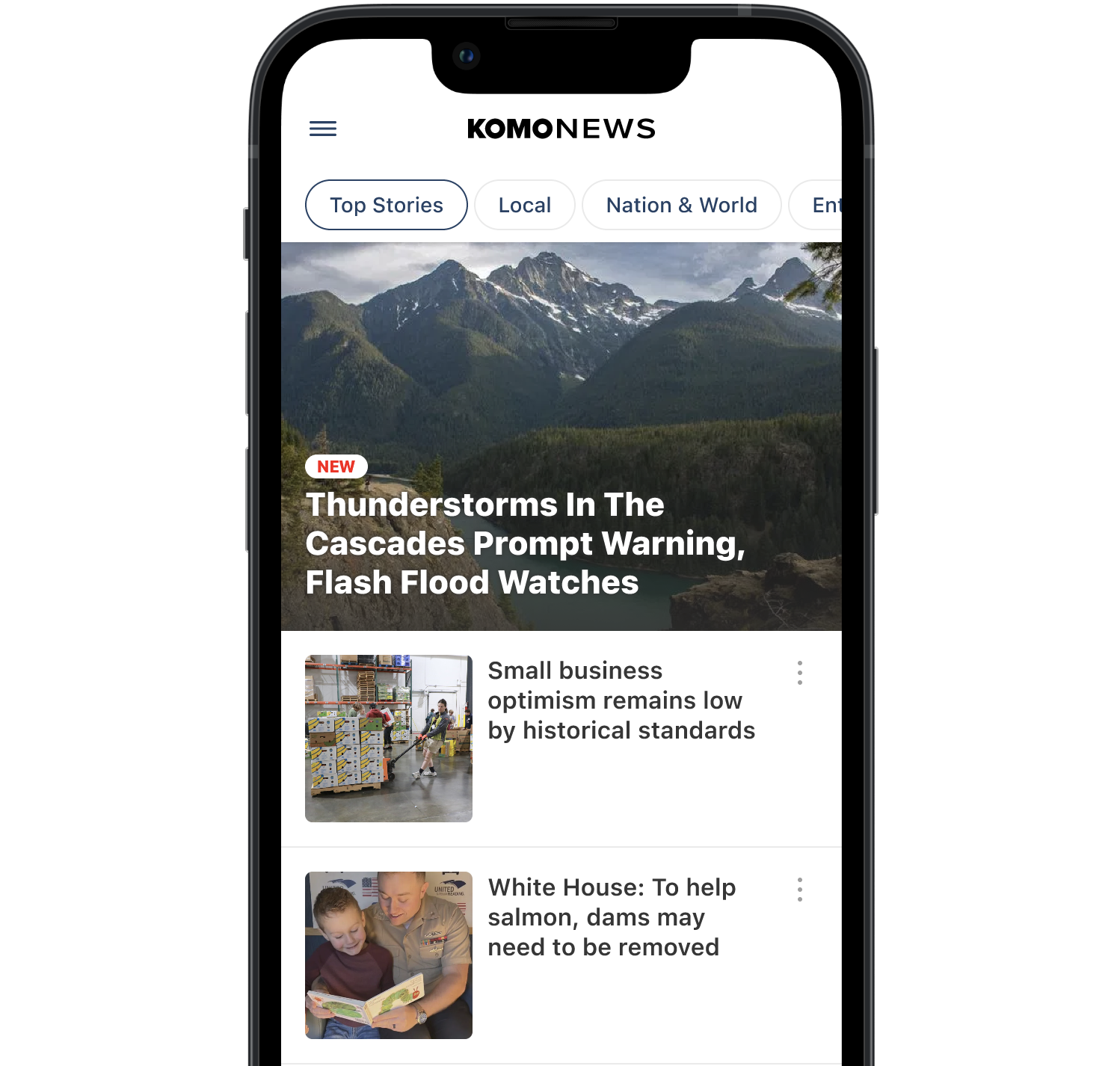
Opportunity
As platforms like TikTok, Instagram, and YouTube reshaped how users consume content, expectations around speed, personalization, and continuous scrolling became standard.
This created an opportunity to explore a new model for news consumption—one that shifts from intentional browsing to passive discovery.
Leadership initiated a redesign effort focused on introducing a short-form, video-first experience inspired by these behavioral shifts. The goal was not to replace the existing system entirely, but to explore a parallel experience that could evolve alongside it.
Exploration
To understand how short-form and news content could coexist, I conducted a competitive analysis across both categories. This included platforms such as Inshorts, alongside major social and video platforms.
Key observations
Short-form video platforms have established consistent interaction patterns such as vertical scrolling and infinite feeds.
News applications largely remain anchored in static or list-based navigation.
Summary-based news apps reduce reading friction, but often lack depth and multimedia integration.
There is no widely adopted model combining AI summaries, video shorts, and structured news context.
Design direction
Rather than introducing new interaction models, the approach focused on adapting familiar behaviors. Vertical scrolling became the primary navigation pattern, supported by feed-based discovery instead of manual browsing.
Content was designed to be lightweight and glanceable, making it easier to consume quickly. The intent was to align with existing user mental models while introducing a new content structure.
Principles
From this exploration, several core principles guided the design direction.
Speed and Clarity: Content should load quickly and be immediately understandable.
Familiar Interaction Patterns: The experience should leverage established scrolling and feed behaviors.
Accessibility Across User Groups: The design must remain usable for both younger audiences and long-time older users.
Controlled Depth: AI-generated summaries should be concise, informative, and intentionally non-exhaustive.

Video Shorts
Solution
The redesigned experience introduces a modern short-form feed alongside the traditional news experience, minimizing user friction through a phased, dual-format rollout strategy.
1. Initial Phase: Video Shorts Feed
The first release focused on a full-screen vertical video experience to capture immediate broadcast engagement:
Format & Media: Continuous, full-bleed vertical video clips, including reporter updates, weather highlights, and breaking news clips.
Interaction Model: Auto-advancing video playback with vertical swiping to move between stories, inline sharing, and direct links to full written articles.
2. Follow-up Phase: Story Shorts & AI Summaries
To serve readers in low-audio or on-the-go environments, the short-form experience was expanded to include bite-sized visual card summaries:
Format & Media: Visual image cards paired with concise, AI-generated summary text constrained by strict character limits for immediate clarity.
Interaction Model: Tap-through navigation driven by segmented top progress indicators (similar to social media story feeds), allowing users to scan key regional updates rapidly without requiring audio.
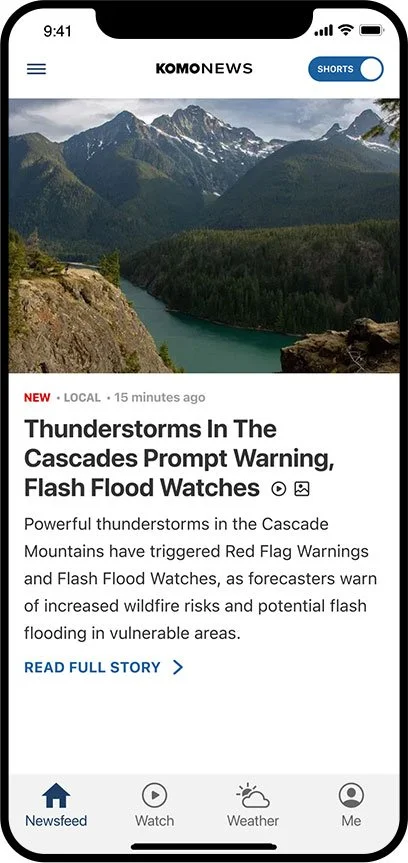
3. Entry & Experimentation Strategy
To validate the new experience while minimizing risk to core app retention, the feature was introduced through a controlled A/B testing framework:
Cohort Grouping: Users were split into groups—one experienced the short-form view as their default entry point, while the other remained in the classic list view with opt-in entry points.
Teaser Modules: A horizontal carousel tray was integrated into the classic feed, allowing users to discover short-form content organically without forcing a sudden transition.
Dual-Mode Navigation: A view-switching control enables users to toggle between the classic list view and the short-form feed at any time, preserving familiar navigation patterns.
4. Onboarding & Progressive Guidance
To support adoption across a diverse user base, lightweight onboarding elements were introduced across both feature formats:
First-Time Overlays: Clear, non-intrusive entry screens welcoming users to the new feed.
Contextual Tooltips: Brief interaction hints guiding users through vertical swiping (for video) and horizontal tapping (for story summaries).
Story Shorts
5. Accessibility and UI adaptation
The interface was designed to accommodate a wide range of users, including those with accessibility needs. This includes support for dynamic font scaling without breaking layouts, as well as adaptive teaser imagery to maintain visual balance.
Outcomes & Early Learnings
To evaluate user adoption and engagement across different media formats, controlled A/B beta tests were deployed across initial station cohorts to compare Video Shorts and Story Shorts against the classic news list view.
1. Video Shorts (Full-Screen Vertical Video)
High Individual Engagement: Users who navigated into the Video Shorts feed showed strong intent, watching multiple vertical clips per session.
Growing Watch Time: Average session watch time trended upward over initial beta weeks as users engaged with video highlights.
Adoption & Entry Friction: Initial navigation entry rates remained limited compared to the classic feed, indicating that video discovery requires clearer entry points and stronger onboarding prompts within the home feed.
Platform & Scroll Behavior: Early usage showed that a significant portion of video viewers remained near the initial entry clip rather than scrolling deeply through the infinite feed.
2. Story Shorts (Tap-Through Visual Summaries)
High Retention: The vast majority of users who defaulted into the Story Shorts view chose to remain in the experience rather than switching back to the traditional list view, demonstrating strong baseline acceptance.
Increased Session Duration: Sessions in Story Shorts consistently yielded longer overall time spent compared to the classic list feed.
Effective Content Launchpad: Story Shorts drove a higher rate of individual story detail page views per session compared to the traditional layout, proving that bite-sized visual summaries effectively encourage deeper article reading.
Monetization Viability: Successfully validated native inline ad insertions within the story card flow without causing premature session abandonment.


